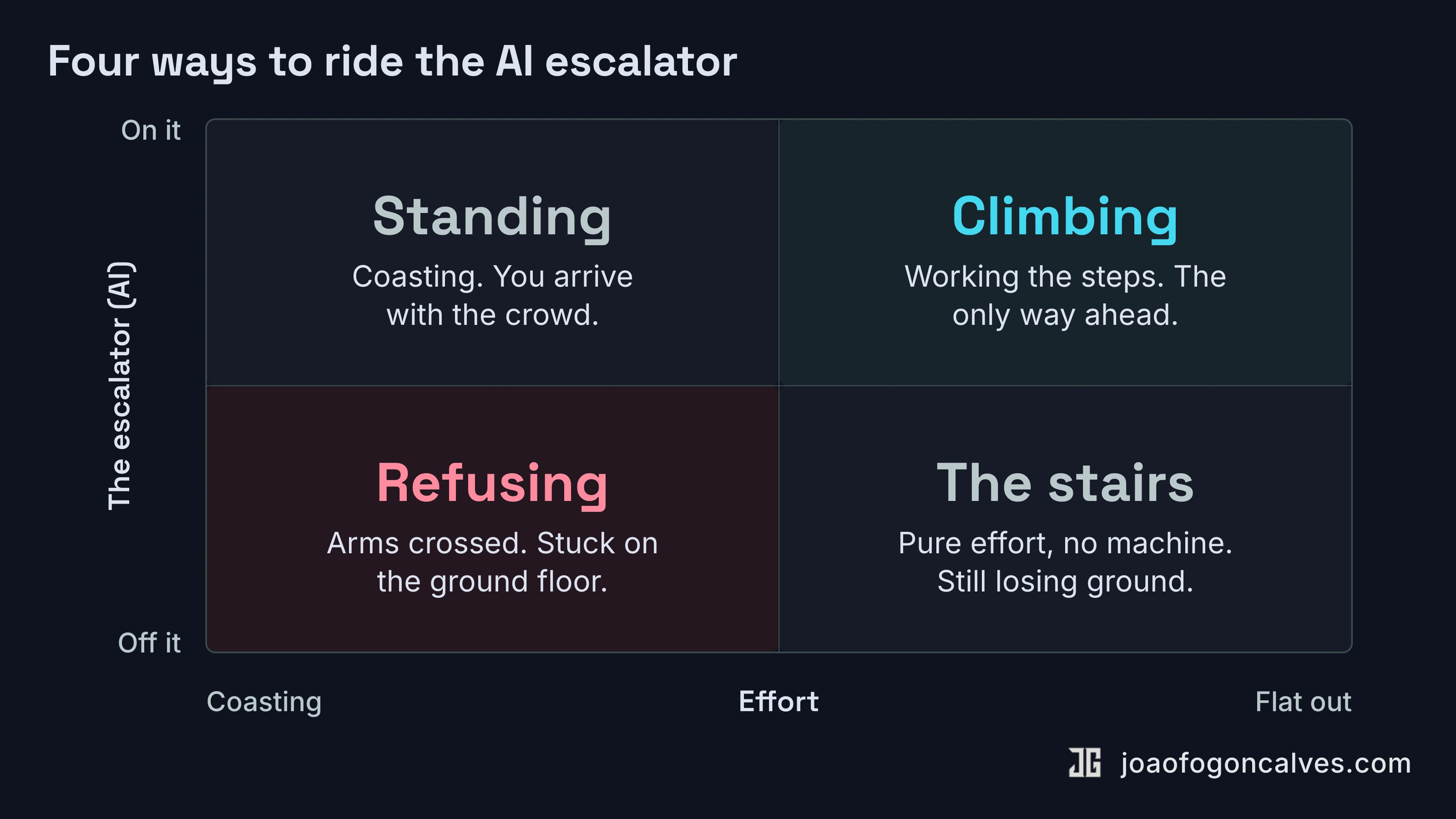
Picture an escalator. At the top is wherever you’re trying to get: the things you want to build, the depth you want to understand, the level you want to operate at. The closer you get, the further the top moves. One escalator runs up, stairs winding alongside. Four ways to make the climb.
You can refuse the whole thing. This is the Luddite move, the it’s-all-hype move, the not-for-my-job move. Arms crossed at the bottom while everyone rises past you. Dignified. Also still on the ground floor, watching the backs of their heads shrink into the distance.
You can take the stairs. Honest work. In every tech shift before this one, the stairs got you there. Pure effort, no tools, slower but you arrived, sometimes ahead of the people who waited for the machine.
You can step onto the escalator and stand. Where most people are. It carries you up, no effort, and it feels like progress because the floor is moving under you. The catch: everyone else standing on it moves at the same speed. You arrive when they arrive. You just arrive less tired.
Or you can step onto the escalator and climb. Same machine, twice the rate. The escalator handles the baseline. Your legs do the rest. You pass the standers. You pass the stair people. You’re at the top before anyone’s worked out why.
AI is the escalator. Except this one keeps accelerating.
That’s what breaks the stairs. In slower revolutions, raw effort could still get you to the top. This escalator is already moving faster than anyone can climb beside it, and it’s still picking up speed. You take the steps two at a time, flat out, and the riders pull away anyway. The gap widens the longer you climb.
Refusing keeps you on the ground. The stairs no longer catch up. Standing keeps pace. Only climbing the moving steps gets you ahead.
The gap was never refusing versus adopting. Everyone able to is on the escalator now. The gap is standing versus climbing.
One of those still feels like enough.